Dashboards tell you what happened. I wanted something that acted on my behalf, with judgement, personality, and a schedule, without me opening another app. The shape of personal analytics had stalled in the same place for a decade: more charts, more notifications, more dashboards I would dutifully look at and act on roughly half the time. What was missing was not data. It was the agent who would read the data on my behalf and tell me, in a voice I would actually read, what to do about it.
The problem
Personal analytics products still require me to show up. Email piles up. Bills drift. Homelab disks fill quietly. The personal-budget platform I built ingests bank data and surfaces anomalies, but the platform does not nudge me to look at the dashboard the way a competent assistant would. The gap is not more measurement. It is operationalised insight, delivered at the right moment, in language I will read.
Generic automation scripts fail because they cannot prioritise. They send the same notification at the same time whether it matters or not. I needed agents with domains, characters, and skills, not one monolithic bot that did everything in the same flat voice.
The approach
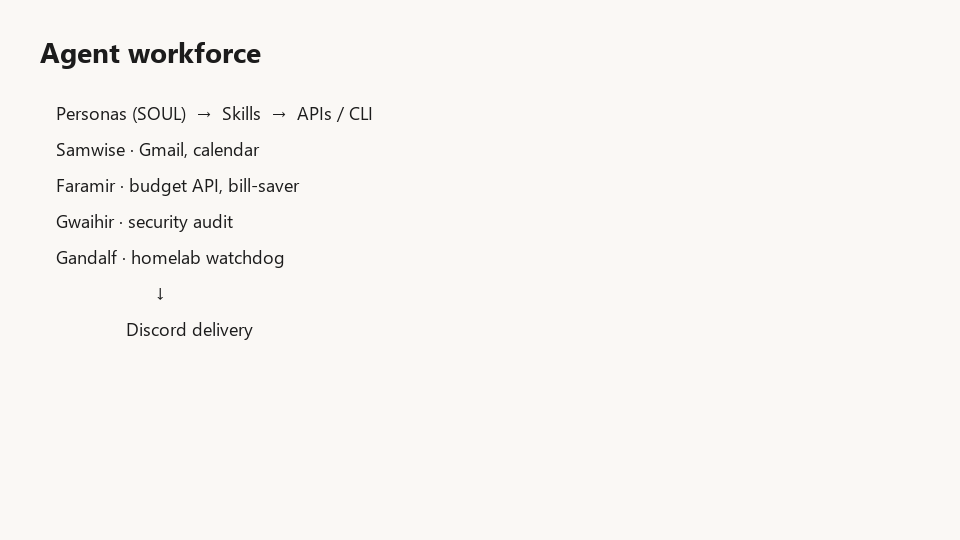
A workforce of four named personas runs on a Raspberry Pi (shire-pi), orchestrated by Hermes Agent v0.14. Each agent has:
- A SOUL.md that defines character, voice, and operational boundaries
- A Discord gateway as its delivery surface for scheduled output
- A set of skills that wrap real systems (Gmail, calendar, finance API, bill-saver, homelab probes), where the LLM is the brain and the CLI is the hands
- Cron jobs stored per profile at
~/.hermes/profiles/{persona}/cron/jobs.jsonso the schedule lives next to the agent it belongs to
| Persona | Domain | Scheduled work |
|---|---|---|
| Samwise | Gmail, calendar, daily life | Inbox sweep four times a day, labels everything, stars only what needs action, schedules reminders |
| Faramir | Finance, utilities | Daily budget review, monthly electricity and insurance comparison |
| Gwaihir | Security | Weekly Pi security audit and findings summary |
| Gandalf | Homelab | Watchdog every ten minutes, weekly review, learning digest |
In May 2026 I migrated the whole stack from OpenClaw to Hermes. The schedules, the prompts, and the gateway behaviour all stayed the same. What changed was the skill layer underneath: Samwise’s Gmail integration now uses the Google Workspace gws CLI with OAuth, which gave the agent a cleaner read on labels and a more reliable handle on starring.
Design principles
- Judgement over scripts. Samwise’s Gmail skill says it plainly in its prompt: “You are the brain. The CLI is just your hands.” Stars mean “the boss should see this.” Labels mean “filed and forgotten.” The agent decides, the CLI executes.
- Rule-bound finance. Faramir’s bill-saver pulls structured data from the personal-budget API, classifies bills, applies market-context rules, and ranks switch recommendations. The agent never invents a price. If the data is not there, the recommendation is not made.
- Structured ops reporting. Gandalf’s weekly homelab review uses a fixed template: Wrong, Creeping, New, What I would do. Same shape every week, comparable across weeks.
A day in the life
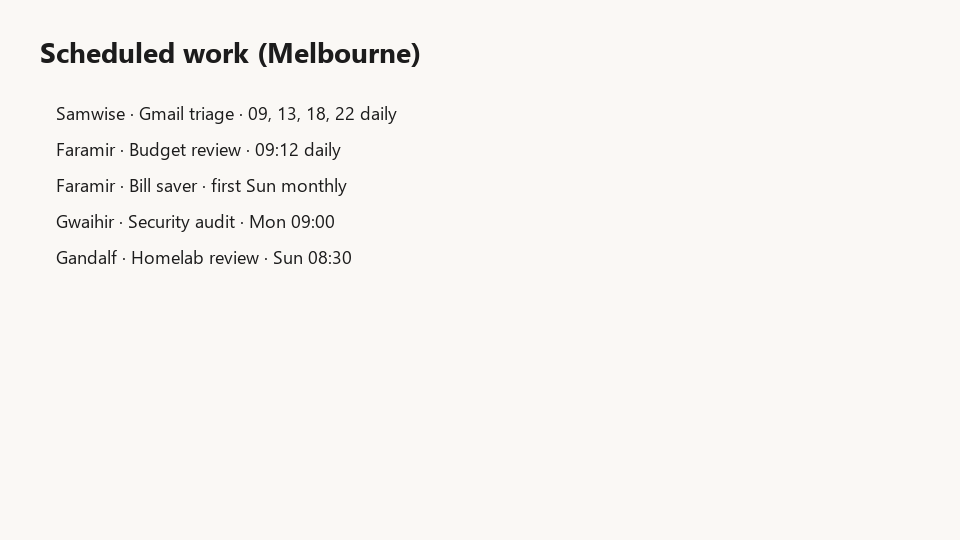
- 09:12 Faramir posts a 60 to 100 word budget nudge: yesterday’s spending pattern, savings trend, one actionable suggestion.
- 13:00 Samwise sweeps Gmail. Hierarchical labels applied, selective stars, calendar nudges for time-bound items I would otherwise miss.
- Monday 09:00 Gwaihir summarises the security audit findings in plain bullets.
- Sunday 08:30 Gandalf delivers the homelab weekly review.
Evidence
- Four named personas, each with their own SOUL.md, Discord channel, and cron schedule
- Daily integration with Gmail, calendar, finance API, and homelab probes
- Stack migrated from OpenClaw to Hermes with no loss of schedule, prompt content, or gateway behaviour
- Canonical workspace at
hermes-shireholds persona definitions, prompt templates, migration runbooks, and recovery docs, version-controlled and separate from the live Pi runtime - Roadmap items (career research, utilities comparison, LinkedIn engagement) extend the workforce by adding skills and cron prompts, not by editing the agents themselves
This is not a chatbot demo. It is an operational platform I depend on, and the design patterns are the same ones I use at work: named roles, clear domains, scheduled delivery, human-in-the-loop guardrails, integration with the systems that already hold the truth. Personal scale, professional discipline.