Call quality programmes generate rich qualitative data. Expectation ratings, reflection notes, development feedback, action plans, the whole conversation between a colleague and their coach written down at speed. The risk is that privacy constraints kill the utility: you cannot show one colleague’s bad day to leadership, you cannot quote a reflection in a slide, you cannot let a department average leak the identity of a struggling team of two. The design challenge is making team-level insight visible while individual exposure stays mathematically impossible.
The problem
A large financial services organisation needed a call observation platform that did several things at once. It had to structure call observations against an expectation framework, surface dashboards at department level, run text analytics on reflection notes to find recurring themes, and produce leadership narratives that told a story without exposing any individual.
The hard constraint was a minimum of five colleagues per aggregate. No exceptions for under-threshold groups. The system had to enforce this in the schema and in the UI, not as a documented exception process that someone might forget under pressure.
The approach
A privacy-first, layered architecture where the aggregation rules are not a feature you can turn off.
Data model. Colleagues, organisational units, observations, expectation ratings, development feedback (the More, Better, Different, Less framework), and action plans. SQLite with migration scripts and synthetic seed data, so demos can run against plausible data without touching production records.
Backend. Flask application with a repository pattern, authentication middleware, and rate limiting. Business logic separated from data access, because the privacy rules belong to the business layer and have to apply uniformly regardless of how the data is queried.
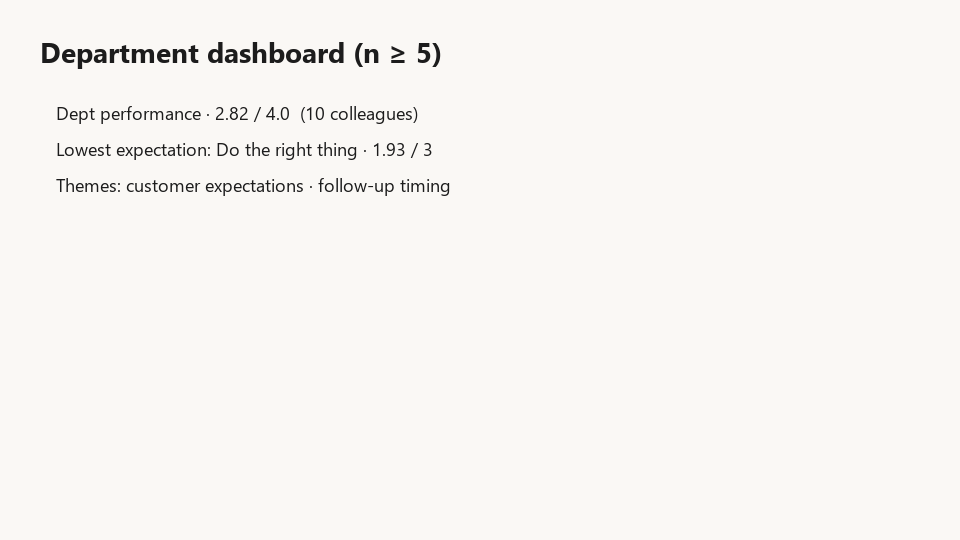
Dashboards. Performance metrics by department, language evolution over time, hotspot views highlighting expectation categories with the lowest scores. Every chart sits behind a check: if the underlying cohort drops below five, the chart renders a placeholder rather than the data. The rule does not depend on the user remembering to apply it.
Text analytics. Theme extraction on pooled reflection notes rather than single observations. Patterns like “customer expectations” or “follow-up timing” surface across a cohort. Individual quotes never leave the data store; only the themes the coach or leader can act on.
Presentation layer. Demo storyboards for leadership sessions: struggling department turnaround, excellence recognition, cross-team comparison. Each grounded in aggregated metrics that pass the five-person floor, so the narrative is plausible without being any real team’s actual data.
A worked example
An account management cohort of ten colleagues yields around 960 observations across a quarter, comfortably above the privacy floor. The expectation category “do the right thing” averages below the organisational baseline. The development feedback themes cluster on customer expectations and follow-up timing. Leadership acts on the category, not on any one person, and the coaching conversation is informed without being prescribed.
Evidence
- Five-colleague minimum enforced in the schema and the UI, not in process documentation
- Text analytics operates on pooled notes, never single-observation quotes in leadership views
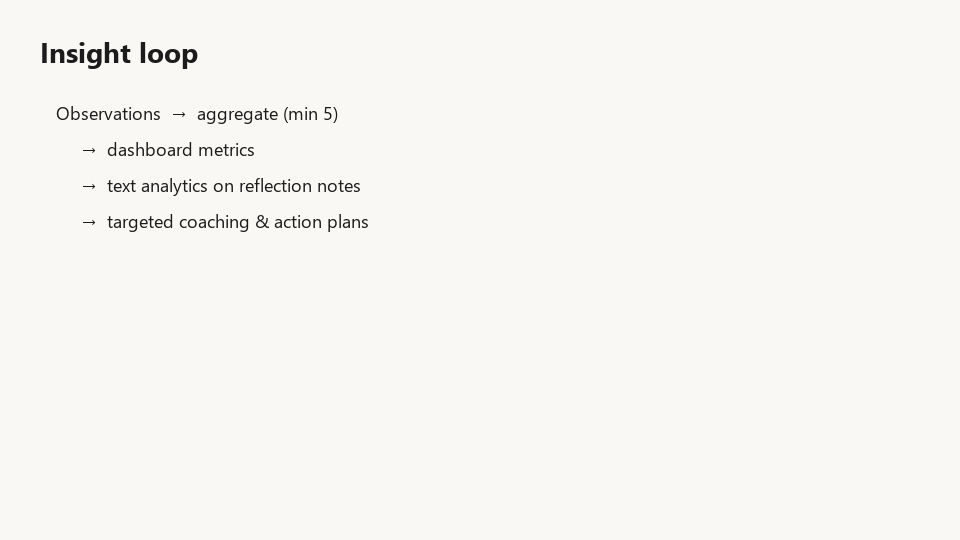
- Action plans link an aggregated finding to structured development steps, closing the loop from measurement to coaching
- Synthetic seed data and presentation templates allow stakeholder demos without exposing live colleague records
- Layered architecture means changing the privacy floor or the aggregation rule is a single configuration change, not a migration
This is what analytics governance looks like as a feature rather than an afterthought. The platform turns operational capture (observations) into aggregated visual insight (dashboards) and thematic analysis (text), and the things you are not allowed to do are things the system will not do.