Platform comparisons are usually written from documentation. This one was written from three build logs. The same healthcare use case, a medical practice assistant handling appointment booking, practice information and symptom triage, was implemented from scratch on Flow XO, assembled from templates on ManyChat, and rebuilt as intents and slots on Amazon Lex. Comparing the products is easy. Comparing the experience of building the same thing on each of them is where the useful differences live.
The short version: every one of these platforms markets itself on ease of build, and the ranking of how easy they actually were is not the ranking their marketing implies.
“No-code chatbot” is a claim, not a specification. Every vendor makes it, and it is technically true for all of them in the sense that you can produce a conversational interface without writing code. What it does not tell you is which organisation can actually staff the work. That distinction matters more than the feature grid. A tool a marketing coordinator can deploy alone and a tool requiring a cloud engineer are different procurement decisions, different budgets, and different failure modes, even when both tick “supports appointment booking”.
Holding the use case constant is what makes the comparison honest. Healthcare gives it teeth: booking flows need multi-turn state, symptom questions need boundaries around medical advice, and anything touching patient data needs a compliance answer. A platform can look capable on a trivial FAQ bot and fall apart on any of those.
The work was submitted as two assessments. The first built and compared Flow XO and ManyChat as standalone tools. The second added Amazon Lex to test whether a platform ecosystem changes the answer. It does, but not in the direction the marketing suggests, and the recommendation that came out of it is tiered by who can maintain the build rather than by what the platform can do.
In brief
- One healthcare use case (appointment booking, practice information, symptom triage) implemented three times, from scratch on Flow XO, from templates on ManyChat, and as intents and slots on Amazon Lex
- Lex bot built with three custom slot types (
ServiceType,AppointmentDate,AppointmentTime); onlyAMAZON.AlphaNumericwas available built-in under AWS Academy restrictions - Four-turn booking dialogue verified end to end: automated slot elicitation across all three slots, full-confidence intent recognition, state transition from
InProgresstoReadyForFulfillment - ManyChat’s AI capability sits behind a USD 29 per month tier, so the free-tier build is template logic rather than language understanding
- Flow XO required no code but did require workflow logic design, including an explicit emergency-escalation path that neither of the others provided by default
- Time to basic proficiency ran roughly 1 to 2 days for ManyChat and 2 to 3 for Flow XO; Lex was not measured in days because the prerequisite is AWS knowledge rather than tool familiarity
- Lex is the only one of the three arriving with HIPAA compliance, encryption and audit trails already answered
- Recommendation tiered by organisational capability, not feature count, on the finding that the binding constraint is who can maintain the build rather than what the platform can do
The reports as submitted
Part one: Flow XO and ManyChat
Introduction
This part evaluates claims surrounding chatbot technology, examining whether chatbots can be developed without coding and assessing their business value in healthcare applications. Two development approaches were selected deliberately: Flow XO built from scratch, for its workflow-focused approach and AI Assistant functionality, and ManyChat built from templates, for its template library and rapid deployment.
Healthcare is a suitable test bed given regulated workflows and high administrative load. Reported figures put patient use of health information chatbots at 52%, with practices reporting 30 to 40% reductions in administrative workload through automation (MGMA 2025).
Evaluation methodology
The framework assessed each tool against chatbot definition compliance, AI and machine learning functionality, template system effectiveness, complex functionality, primary function alignment, learning curve, and non-technical user accessibility. Healthcare-specific criteria were added: patient safety protocols, privacy compliance under the Australian Privacy Principles, clinical workflow integration, and medical information accuracy.
Evidence was captured through step-by-step runs of each flow, recording the trigger, user input, bot response, branching and fallbacks, with screenshots of configuration screens alongside the corresponding chat transcripts.
Flow XO, built from nothing
No templates. A Flow Builder workflow with an AI Assistant configured with a custom persona, goal and instructions, describing a professional, empathetic healthcare assistant working for an Australian medical practice. Multi-step patient registration with conditional logic, appointment scheduling, and explicit emergency protocols for handing off to a human when medical urgency is detected.
The privacy handling had to be designed rather than inherited, and the test console shows it working: the assistant answers a direct question about what data it holds with a scoped answer referring to Australian privacy law, then offers a handoff rather than improvising.
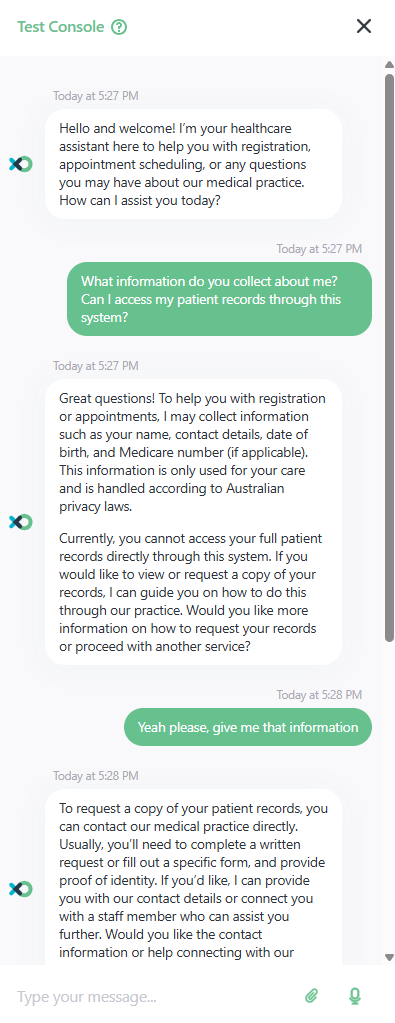
Flow XO’s AI is best understood as language-model-augmented orchestration rather than self-learning. It parses natural language and maintains short-term context, but it does not retrain itself. Improvements come from refining instructions, guardrails and flow logic, which is prompt and workflow iteration rather than online learning. Complex triage still relies on explicit conditions, filters and handoffs defined in the flow.
No code is required, but a non-IT user must sequence blocks, ask a question, store the answer, apply filters, and then test every branch. The evaluation put basic proficiency at 2 to 3 days for someone comfortable with logical thinking.
ManyChat, built from templates
ManyChat’s template model prioritises speed and consistency over deep custom logic. Conversations skew button and menu led, entity capture is basic, and complex triage needs multiple linked blocks. The trade-off is accessibility: a non-technical staff member can duplicate a template, edit the copy, adjust quick replies and publish changes in minutes. Basic proficiency took 1 to 2 days.
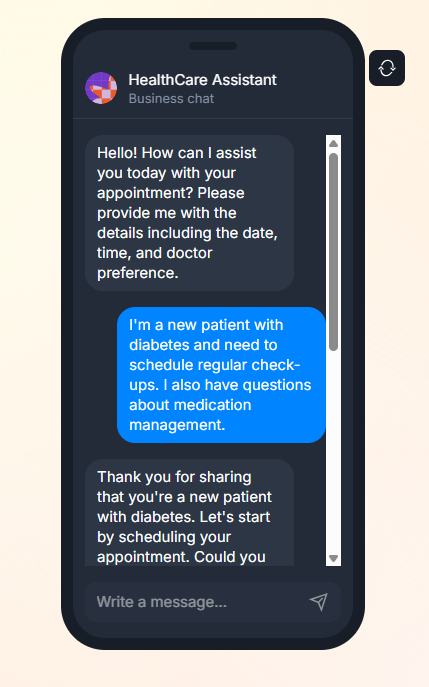
The AI features, including AI replies, rewriting and lead qualification, sit behind the paid tier at USD 29 per month. The free plan therefore demonstrates templated automation rather than adaptive language behaviour. That is appropriate for a no-coding brief and it is also an explicit capability limit worth naming rather than glossing.
The comparison
| Criterion | Flow XO (from scratch) | ManyChat (template-based) |
|---|---|---|
| Meets the definition of a chatbot | Yes, conversational interface with automated, context-aware responses | Yes, conversational interface with structured flows, buttons and menus |
| Provides AI functionality | Yes, AI Assistant with custom persona, goal and instructions | Partial, AI features require a paid subscription at USD 29 per month |
| Template system | No, built entirely in Flow Builder | Yes, extensive library including healthcare-specific options |
| Complex functionality | Strong, multi-step workflows, conditional logic, data collection, emergency protocols | Adequate, template customisation, lead capture, booking flows |
| Primary function | Patient management, intake, registration, scheduling, symptom assessment | Lead generation, patient engagement, FAQ responses, marketing automation |
| Learning curve | Moderate, requires workflow logic and AI configuration | Easy, visual builder over prebuilt templates |
| Non-technical accessibility | Moderate, 2 to 3 days to basic proficiency | Easy, 1 to 2 days to basic proficiency |
| Patient safety handling | Emergency protocols and medical boundaries designed explicitly | Template-level safety protocols |
| Privacy compliance | Configurable to Australian Privacy Principles | Basic measures inherited from templates |
Verifying the claims
Chatbots can be developed without coding. Verified for both. Neither platform requires traditional programming. Flow XO requires logical thinking and workflow design; ManyChat requires minimal technical knowledge for template customisation. The claim is true and it is also incomplete, because the skill it displaces is programming, not design.
Chatbots can learn and improve their interaction. Partially verified, and the partial matters. Flow XO improves through human-driven prompt and flow refinement, not autonomous model fine-tuning. ManyChat’s adaptive features are behind a paywall, so on the free tier the claim is not demonstrable at all. Neither platform, as built here, learns in the sense a reader of the marketing would assume.
Chatbots represent business value. Verified in kind if not in amount. Both platforms reduce administrative handling for routine enquiries and both automate booking. The dollar figures behind that are not something this evaluation measured.
The technology is accessible to non-technical users. Verified, with a gradient. ManyChat is genuinely accessible. Flow XO is accessible with training and a tolerance for workflow logic.
Business applications and healthcare considerations
Both platforms implement medical boundary management correctly, refusing to provide diagnoses and directing urgent cases to human clinicians. Both address Australian privacy requirements, though Flow XO provides finer control because the handling is configured rather than inherited.
Both also require integration with existing practice management systems, which is where a small practice’s real implementation cost sits. Custom Flow XO workflows need ongoing management; ManyChat templates need periodic re-customisation as practice needs change. Neither is maintenance-free.
Part two: Amazon Lex
Introduction
The second assessment introduces Amazon Lex as a platform-based solution, shifting the question from tool comparison to whether a platform ecosystem changes the answer. Part one demonstrated the advantages of standalone platforms, Flow XO’s workflow customisation and ManyChat’s template accessibility, while revealing limits in scalability and enterprise integration for complex healthcare organisations.
Lex is a different proposition: a cloud conversational AI service built on the same speech recognition and natural language understanding technology as Amazon Alexa, sitting inside the AWS ecosystem.
Methodology
The evaluation extends the part one framework with platform-specific criteria while keeping the healthcare use case constant, which is what allows direct comparison. Evidence sources include AWS documentation, published healthcare case studies, and hands-on implementation of a ClinicVirtualAssistant bot for appointment booking.
Core functionality
Lex lets you define intents, meaning user goals, with example utterances, and the underlying model generalises from those examples to phrasings nobody enumerated. That is a real advance over the rule-based and template-driven approaches in the standalone platforms, where an unanticipated phrasing simply falls through to a fallback.
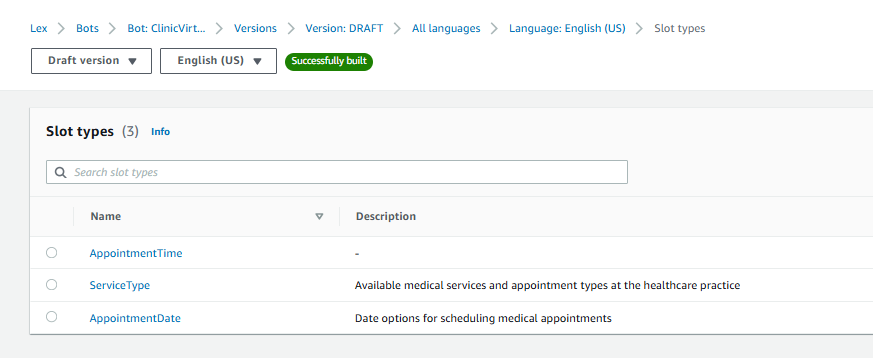
The intent recognition system supports slot extraction with built-in types for dates, numbers and locations, plus custom slot types for domain-specific terminology. Lex V2 added native support for context management and multi-turn dialogues, so a bot maintains conversation state without custom code, which is functionality that had to be engineered by hand in Flow XO.
Recent additions extend Lex toward hybrid approaches, incorporating large language models through Amazon Bedrock for conversational FAQ handling and assisted slot resolution. These handle unstructured input while keeping the deterministic behaviour healthcare needs. Unlike a purely generative solution, Lex stays grounded in defined data sources and approved content, which reduces the risk of inappropriate medical advice.
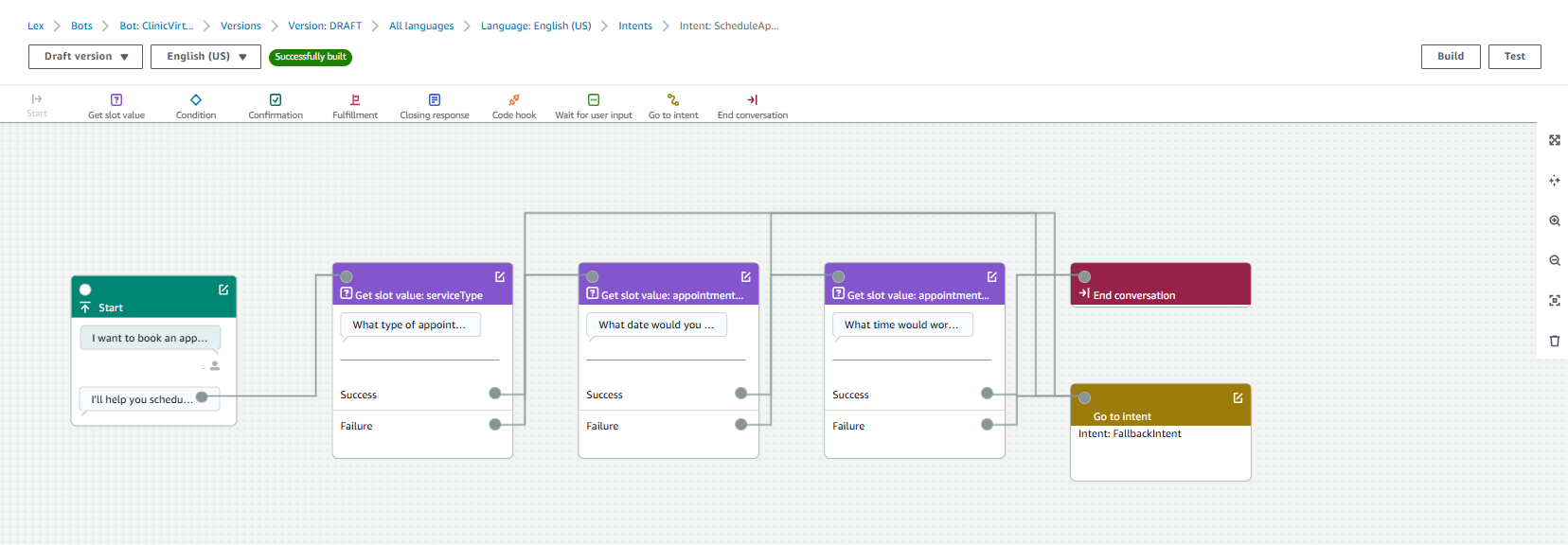
The intent configuration itself shows what the design actually involves: a start block, three sequential slot elicitation blocks each with success and failure branches, an end-conversation path and a fallback intent.
Hands-on implementation revealed a gap between Amazon’s marketing and the practical development experience. The promised easy bot building requires substantial technical expertise, custom slot type design and detailed intent configuration.
Platform integration and ecosystem
Lex’s primary differentiator is AWS integration: Lambda functions for business logic, DynamoDB for state, CloudWatch for monitoring. That enables healthcare applications with real-time data access and system orchestration that standalone platforms rarely reach.
The healthcare-specific advantages are concrete. HIPAA compliance, encrypted storage and audit trails arrive already answered, which for a regulated deployment is not a small line item. The platform supports web, mobile and SMS deployment from one backend, and AWS documents implementations processing millions of messages daily.
Hands-on development
Integration testing confirmed slot elicitation across the three custom slot types: ServiceType for medical services, AppointmentDate for scheduling options, and AppointmentTime for practice hours.
The four-turn booking dialogue worked as designed, with slot elicitation running automatically through serviceType, then appointmentDate, then appointmentTime, intent recognition at full confidence, and dialogue state moving from InProgress to ReadyForFulfillment.
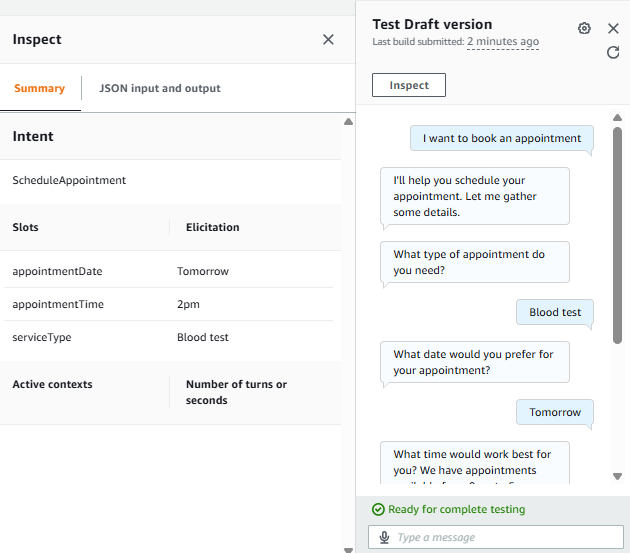
Implementation challenges included AWS Academy permission restrictions and, more consequentially, the availability of only AMAZON.AlphaNumeric as a built-in slot type. Every domain concept had to be defined from scratch. Those barriers are a small version of the vendor dependency argument: the capability that makes Lex attractive is the same capability that makes you dependent on the account, the region and the permissions you have been granted.
Comparative analysis
Lex is clearly ahead on AI functionality, because deep learning models outperform the keyword matching and rule evaluation in the standalone tools, and clearly ahead on complex functionality, because clinical decision support, record system integration and multi-system orchestration are achievable where they are not on Flow XO or ManyChat.
The reversal is on who can run it. ManyChat lets a marketing team deploy independently. Flow XO lets a business analyst build workflows with minimal IT support. Lex typically requires cloud engineers, developers and AWS expertise, which changes the implementation model from business tool to software project. Practical development required AWS console navigation, an understanding of intent-to-slot relationships, dialogue flow design and custom slot type creation, none of which is needed to select a ManyChat template.
That is the finding the build log produced and a feature grid would not. The gap between the marketing and the build was widest exactly where the marketing was loudest.
Platform versus standalone
The choice is a familiar strategic trade between breadth of capability and simplicity of implementation.
Lex’s platform approach provides access to AWS’s research pipeline, continuous model improvements and ecosystem effects that standalone vendors cannot match on their resources. Standalone platforms excel in specialisation and accessibility: ManyChat’s focus on social channel automation and Flow XO’s workflow-centric design reflect concentrated development on specific use cases, and they enable deployment for organisations with limited technical resources. They also reduce vendor management overhead and give predictable subscription costs rather than usage-based cloud pricing.
Lock-in cuts both ways. AWS adoption creates dependency on Amazon’s roadmap and pricing decisions while providing access to Amazon’s investment in conversational AI. Standalone platforms offer independence and may limit capability expansion as needs evolve. The innovation pace differs correspondingly: AWS ships fundamental capability changes such as large language model integration and automated bot design, while standalone vendors typically focus on user experience refinement and niche features.
Neither is right in the abstract. Choosing between them from a feature grid rather than a build log is how organisations end up with a platform their people cannot run.
Healthcare business value
The strongest published example is InpharmD’s clinical decision support implementation on Lex, reported at 94% accuracy against human experts with a 16% reduction in literature research time, saving roughly three hours per clinician query (AWS Machine Learning Blog 2023). That figure comes from AWS’s own publication and should be read accordingly, but the scale claim is separately evidenced by pandemic-era deployments processing millions of daily messages.
The value framework across all three platforms is the same in kind: 24/7 availability and consistent service quality for patients, administrative automation for staff, and audit capability for compliance. What differs is the ceiling and the cost of reaching it. Organisations with an existing AWS presence show higher implementation success. Those without cloud expertise face change management difficulty and a real risk of over-engineering a problem that a template would have solved.
Recommendations
The recommendation is tiered by organisational capability rather than by feature count.
Small practices should take ManyChat and accept the ceiling, because the alternative is a capable platform nobody can maintain.
Medium organisations should take Flow XO for workflow control that stays business-owned. Enough control to design an emergency handoff properly, little enough technical overhead that a business analyst can own it. That middle position turned out to be the most defensible one for a mid-sized practice.
Large health systems already running on AWS should evaluate Lex, because for them the integration, compliance and scaling story is worth the engineering cost, and they are the only ones who can absorb it.
Implementation should be phased regardless of platform, beginning with limited scope such as FAQ automation or basic scheduling before advancing to complex workflows. The success factors are executive sponsorship, cross-functional collaboration between IT and clinical staff, and iterative development that allows the organisation to adjust as it learns.
Conclusion
Lex demonstrates clear technical superiority and enterprise readiness compared to Flow XO and ManyChat, particularly for healthcare applications requiring integration and regulatory compliance. Hands-on implementation equally confirmed technical barriers that contradict the marketing claims of simplified development.
Healthcare organisations should select platforms on strategic objectives and technical capability rather than on marketing promises. Standalone platforms remain relevant for rapid deployment and focused use cases. Platform solutions suit organisations with existing cloud infrastructure and a broader digital programme underway. The assessment that matters is not which platform can do more, but which one the organisation can still be running in two years.
References
Amazon Web Services 2024, Amazon Lex features, AWS Documentation, viewed 2025, https://aws.amazon.com/lex/features/
Australian Privacy Principles 2024, Office of the Australian Information Commissioner, viewed 15 September 2024, https://www.oaic.gov.au/privacy/australian-privacy-principles/
AWS Industries Blog 2023, ‘Leveraging healthcare chatbots at your digital front door’, AWS Blogs, viewed 2025, https://aws.amazon.com/blogs/industries/leveraging-healthcare-chatbots-at-your-digital-front-door/
AWS Machine Learning Blog 2021, ‘Intelligently connect to customers using machine learning in the COVID-19 pandemic’, AWS Blogs, viewed 2025, https://aws.amazon.com/blogs/machine-learning/intelligently-connect-to-customers-using-machine-learning-in-the-covid-19-pandemic/
AWS Machine Learning Blog 2023, ‘How InpharmD uses Amazon Kendra and Amazon Lex to drive evidence-based patient care’, AWS Blogs, viewed 2025, https://aws.amazon.com/blogs/machine-learning/how-inpharmd-uses-amazon-kendra-and-amazon-lex-to-drive-evidence-based-patient-care/
AWS Machine Learning Blog 2024, ‘Intelligent healthcare assistants: personalised support and data-driven insights’, AWS Blogs, viewed 2025, https://aws.amazon.com/blogs/machine-learning/intelligent-healthcare-assistants-empowering-stakeholders-with-personalized-support-and-data-driven-insights/
CloudOptimo 2024, ‘Build, integrate, and scale bots with Amazon Lex’, CloudOptimo Blog, viewed 2025, https://www.cloudoptimo.com/blog/build-integrate-and-scale-bots-with-amazon-lex/
Flow XO 2024, AI assistant configuration guide, viewed 15 September 2024, https://flowxo.com/docs/ai-assistant/
HIPAA Journal 2019, Amazon Lex is now HIPAA compliant, viewed 2025, https://www.hipaajournal.com/amazon-lex-is-now-hipaa-compliant/
ManyChat 2024, Template library and customisation, viewed 15 September 2024, https://manychat.com/templates/
MGMA 2025, Sizing up the market for AI chatbots, virtual assistants in medical practices in 2025, Medical Group Management Association, viewed 2025, https://www.mgma.com/mgma-stat/sizing-up-the-market-for-ai-chatbots-virtual-assistants-in-medical-practices-in-2025
Parker, G, Van Alstyne, M & Choudary, SP 2016, Platform revolution: how networked markets are transforming the economy and how to make them work for you, 1st edn, W. W. Norton, New York.
Sufyanahmad 2024, ‘Comparing conversational AI platforms: Dialogflow vs IBM Watson Assistant vs Microsoft Bot Framework vs Amazon Lex vs Rasa’, Medium, viewed 2025, https://medium.com/@sufyanahmad838/comparing-conversational-ai-platforms-dialogflow-vs-ibm-watson-assistant-vs-microsoft-bot-9f9143ea71a7